 Getty ImagesSave this storySave this story
On the occasion of Marilyn Monroe’s 100th birthday, Allure revisits a story journalist and author Rebecca Mead wrote for our August 2012 issue to commemorate the 50th anniversary of the star's death. In the piece, Mead examines Monroe's legacy, and how her disarming beauty still holds the power to seduce today.
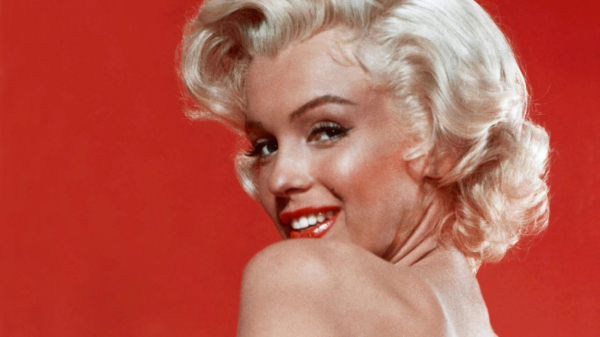
In March 1955, Life magazine featured a familiar figure on its cover: an actress with a cap of platinum-blonde curls, her deep-set eyes accentuated with bat-wing eyeliner and high-arched brows, her pink lips parted in a smile that revealed a row of perfect white teeth. It was the look of Marilyn Monroe, who at the time was riding the wave of her comic, bombshell popularity. Less than two years earlier she'd appeared in Gentlemen Prefer Blondes singing “Diamonds Are a Girl's Best Friend,” and within a few months she would be seen again, in another fluttering moment of exposure, having her white dress blown above her knees in The Seven Year Itch.
But the young woman on that 1955 magazine cover was not Marilyn Monroe. She was Sheree North, a 22-year-old former burlesque dancer (and former brunette) whose chance had come: Monroe's studio, Twentieth Century-Fox, had hired North as an alternative to Monroe, casting her in a movie called How to Be Very, Very Popular, in which she played a striptease dancer who witnesses a murder—a role written for, and rejected by, Monroe, who aspired to more serious dramatic work. When, a few months after the Life cover, North appeared as a mystery guest on the TV show What's My Line? and was asked by a blindfolded Bennett Cerf if she had ever been mentioned in the same sentence as Monroe, she replied with some chagrin, “I think that all of us have.”
North's opportunity came and went: After a couple of years she was eclipsed by somewhat more durable Marilyn substitutes, including Jayne Mansfield and Mamie Van Doren. But if North was the first actress who was obliged to mold herself in the remarkable shape of Marilyn, her example has been followed by countless others since.
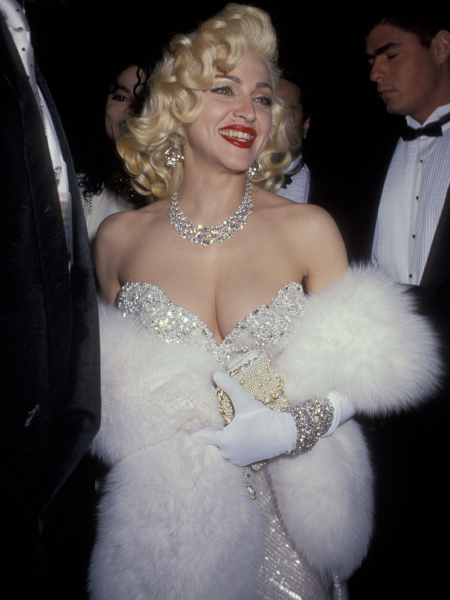
Madonna channeling Marilyn at the Academy Awards in 1991.
Getty Images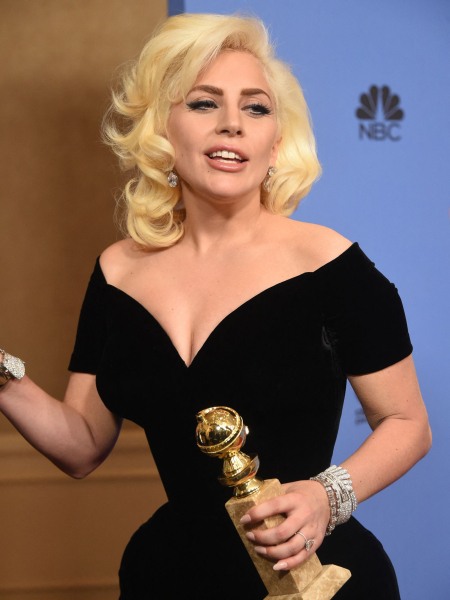
Lady Gaga evokes the starlet at the 2016 Golden Globes.
Getty Images
For many actresses, channeling Monroe, who died 50 years ago at 36 of an overdose of barbiturates, is virtually a rite of passage. Nicole Kidman impersonated Monroe for Australian Harper's Bazaar; Scarlett Johansson did her for a Dolce & Gabbana ad; Lindsay Lohan, an avowed Monroe obsessive who bought a West Hollywood apartment the star once lived in, reenacted for New York magazine the actress's famed nude shoot with Bert Stern, in which Monroe posed behind colored chiffon and bit a pearl necklace. For makeup artist Kevyn Aucoin, Lisa Marie Presley shed her resemblance to one American icon—her father, Elvis—to incarnate, uncannily, that other lost legend. Monroe's likeness is so recognizable that it has been refracted through pop-cultural iterations many times over: Guess model Anna Nicole Smith presented herself as a coarser version of Monroe, while subsequent models for the same brand impersonated Smith impersonating Monroe. Most famously, Madonna took the trappings of Marilyn's look and put them to her own uses: As Gloria Steinem observed in the mid-1980s, “She has imitated Marilyn Monroe's hair, style, and clothes, but subtracted her vulnerability.” And Monroe's blonde legacy is so unmistakable that Lady Gaga's platinum pose recalls Monroe because of its evocation of Madonna.
Why does Monroe endure? She wasn't Hollywood's first voluptuous, fair-haired beauty. She wasn't even Hollywood's first voluptuous, fair-haired beauty who died at a tragically young age: That would be Jean Harlow, for whom the term “blonde bombshell” was coined in 1933, and who died four years later at the age of 26, from kidney failure. But Monroe is the one whose beauty is so instantly recognizable that it can be indicated merely by a handful of components: blonde bouffant hair; sleepy, half-shut eyes; slightly parted lips on the verge of a welcoming smile. Andy Warhol's Marilyn silk-screen prints, which he made in the immediate aftermath of her death and which were reproduced from a publicity photo from the 1953 thriller Niagara, reduced her image to those very components, highlighted in vivid Pop Art color. Monroe's beauty belongs to a common language of American pop culture—a fact that was evident even as early as 1955. As Sheree North observed in Life magazine, “Marilyn's an institution, like Coca-Cola.”
Monroe's own debut on the cover of Life happened in 1952. In what now seems a striking choice of phrase, the magazine characterized the young actress—who had already appeared in small roles in All About Eve and The Asphalt Jungle and was about to be seen in her first starring role, in Don't Bother to Knock—as a “sturdy blonde.” If sturdiness is not the first characteristic that leaps to mind when considering Monroe, whose legend is bound up with her frailness and vulnerability, it's easy to understand why it could have seemed an apposite description back then. Monroe's vital statistics were reported to be about 36-22-35: She was full and fleshy where it mattered, in the breasts and the hips, and narrow and nipped in at the waist. She had, with only the slightest help from the corset-and bra-building industries, a figure that looks to contemporary eyes as if it were generated by digital trickery.
 Getty Images
Even if her curves exceeded the standards of beauty that have prevailed in the fashion industry in recent decades (“I'd kill myself if I was as fat as Marilyn,” Elizabeth Hurley once said), her body shape has an enduring appeal. In 2004, a Polish anthropologist named Grazyna Jasieńska published findings indicating that women with hourglass figures may have higher levels of the hormones that facilitate conception and pregnancy—evidence that there is a possible biological explanation for Monroe's sex-goddess appeal.
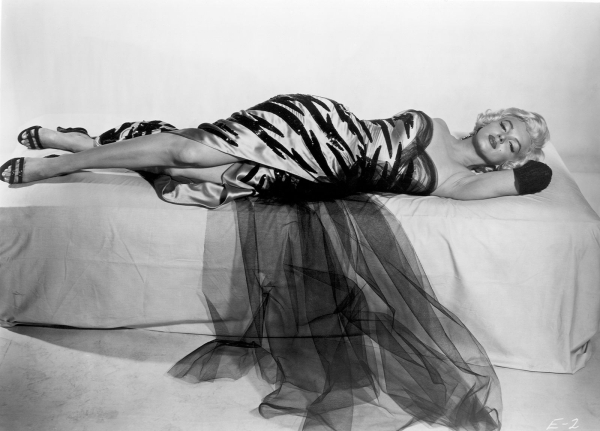
After her first, silent screen test, which was done in 1946 when she was 20, “every frame of the test radiated sex,” according to cinematographer Leon Shamroy, quoted in The Secret Life of Marilyn Monroe (Grand Central Publishing), a biography by J. Randy Taraborrelli. Whether or not she is, as she has sometimes been described, “the world's most photographed woman” (in the digital age, there are probably teenagers with more pictures on Facebook than were ever taken of Monroe), it seems likely that she was the woman most photographed lying down. Even in her first Life shoot, she is seen lounging on a chaise, and so many photographers portrayed her in horizontal languor—including a shot for the first issue of Playboy, in 1953—that it sometimes seems as if she rarely got onto her size-7 feet.
“Women couldn't take her seriously enough to be indignant: She was funny…in a way that made people feel protective.”
Billy Wilder, who directed her in The Seven Year Itch and Some Like It Hot, remarked upon the “luminosity” of Monroe's face. She seemed literally incandescent: her skin was covered with a fair, downy peach fuzz that reflected the light and amplified her glow before the camera. When the studio wanted to wax it off, she wouldn't allow it. Her natural radiance was helped along by surgical interventions. An overbite, which accentuated her pout, was corrected, and a bump on her nose was reduced early in her career.
There was also the aid offered by cosmetics, often applied by her longtime makeup artist, Allan Snyder. For her final movie, The Misfits—during the filming of which she was drinking to excess and abusing prescription drugs—Snyder started working on her while she was still lying in bed in the mornings, because of how long it took her to get up. At the time of her death, her makeup case contained pots of Erno Laszlo creams, as well as a green Leichner of London eye shadow, two Elizabeth Arden Eye Stopper pencil liners, and false lashes made by Glorene of Hollywood. It was auctioned at Christie's in 1999, along with other personal effects, with a pre-auction estimated price of $1,000 to $1,500. The case and its contents sold to Ripley's Believe It or Not! for more than a quarter of a million dollars.
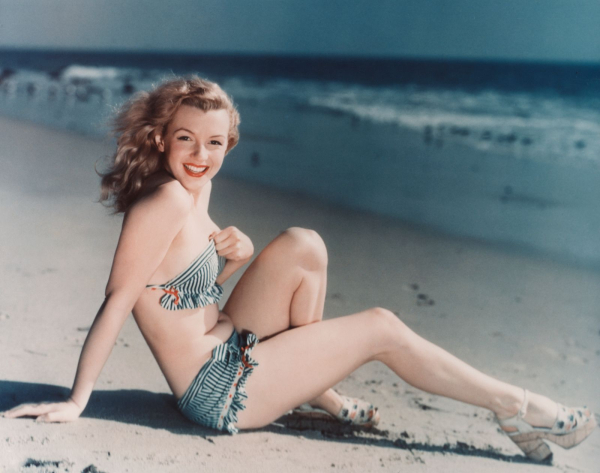
A teenage Marilyn Monroe at the beach.
Sunset Boulevard/Getty Images
Early photographs of Monroe, taken when she was an 18-year-old munitions-factory worker, show her with long brunette curls that were only transformed into what became her signature platinum after she signed with a modeling agency. She turned to Pearl Porterfield, a colorist who had been responsible for Jean Harlow's locks and who used old-fashioned peroxide to achieve the desired result. Monroe would rely upon several hairdressers over the decades, including Kenneth Battelle, who prepared her for her appearance at the birthday gala for President Kennedy. (Battelle also did Jacqueline Kennedy's hair.) Blonde hair—like a high, breathy voice, which Marilyn demonstrated in her presidential serenade—is associated with youth and innocence. Her womanliness was augmented by a childlike cuteness that rendered her unthreatening to other women at the same time that she was irresistibly appealing to men. As Pauline Kael, the film critic, said of her, “Women couldn't take her seriously enough to be indignant: She was funny and impulsive in a way that made people feel protective.”
As an actual child, rather than an onscreen reimagining of one, Monroe had not found protection from those who were most obliged to provide it. Born in Los Angeles in 1926 to a mother who was mentally unstable and ill-equipped to care for her, Monroe—or Norma Jeane Mortensen, as she was then called—spent most of her childhood in a series of foster homes. Later, she said she'd been sexually abused. She was married at 16, to the son of a neighbor, and was divorced for the first time at 19. The hardships of her upbringing are thought to have contributed to her onscreen power: Her beauty was animated by a neediness that commanded attention. In his memoir, Timebends (Penguin), playwright Arthur Miller said of Marilyn, his wife of four and a half years, that she was “the saddest girl I've ever known.”
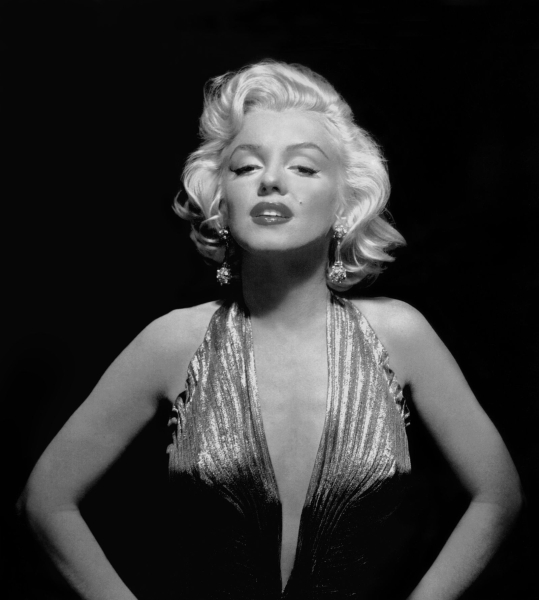
A publicity still from “Gentleman Prefer Blondes.”
Getty Images
The sadness of Monroe's life predominates: The images from the Bert Stern nude shoot, which might have been a kittenish footnote in a longer career, now have the status of a tragic valediction, having been shot six weeks before her death. It is a curious function of celebrity culture that Monroe is now better known for the still images of her than she is for any of the movies she appeared in. She's instantly recognizable to generations who have never even seen Gentlemen Prefer Blondes or Some Like It Hot.
As such, she presents a stilled image of impending tragedy; her dynamism and her kinetic energy are lost—as is the much-lampooned sway of her hips. (“There's a broad with her future behind her,” the actress Constance Bennett reputedly remarked.) The literary critic Diana Trilling wrote in an essay published not long after Monroe's death that to see her in a photo, rather than in a moving image, was to see her diminished, “since no still picture could quite catch her electric quality.” It was that motion and aliveness that powered Marilyn Monroe's beauty—and that helps explain why, although it has been stilled for 50 years, her beauty retains the power to move us today.
Leave a Reply